
MY SHUN KNIVES COLLECTION
Kasumi is a traditional Japanese style of knifemaking in which an extremely hard core of high-carbon steel is clad—that is, sheathed or covered—with an exterior jacket of another steel. The somewhat “softer” exterior cladding protects the inner cutting core. In Japanese, kasumi means “mist” and is so called because the exterior steel can have a lovely misty appearance when compared to the harder cutting core.
Kasumi construction provides an ultimate mix of properties: an extremely sharp edge and ease of sharpening. This clad construction is similar to how samurai swords are traditionally made.
Because of the hard, premium steel from which Shun cutlery is made, the blades can be thinner, lighter, and sharper. A thinner edge cuts more easily by putting less stress on the edge—so fewer strokes do the job. Thinner edges are easier to control as well, making cutting smoother and, once again, relieving stress on the edge.
Shun’s handcrafted Japanese knives are sharpened to a precise 16° angle on each side of the blade (for double-beveled blades, this means a comprehensive angle of 32°). For comparison’s sake, European-style blades are generally sharpened to 20-22° each side for a comprehensive cutting angle of 40-44°.
Due to the premium-quality SG2 and Vg10 steel we use for the cutting core of our blades, Shun’s incredibly sharp edge will nevertheless last an incredibly long time before resharpening is needed. Extremely sharp edges that last an extremely long time—that’s the meaning of Shun’s Extreme Edge.
Steel is a blend (alloy) of iron and carbon. Most steel also has other ingredients in the mix to enhance specific characteristics in the metal. For example, stainless steel also contains chromium to improve stain resistance. Kai Corporation uses the most advanced high-performance steel to create our Shun kitchen cutlery. State-of-the-art manufacturing technology, premium materials, and Kai’s 100-year-old tradition of unparalleled blade-making excellence combine to make Shun cutlery the finest there is.
VG10 stainless steel—adds cobalt for strength and hardness, vanadium for superior edge retention. High-performance VG10 needs minimal care to avoid corrosion, takes a wicked edge, and holds it for a very long time. Resharpening is easy—when the time comes.
SG2 stainless steel—is a proprietary “micro carbide” steel. The ultra-dense grain structure and purity of SG-2 make it both harder and more pliable than other high-performance steels. The result is a knife with the ability to take and hold an incredibly fine edge of unparalleled durability. Because of its combination of extreme edge performance and durability, SG-2 is considered by many to be the world’s best blade material for use in kitchen knives.
| PakkaWood® is a premium handle material made of genuine hardwood impregnated with resin. The resin makes it moisture resistant, strong, and durable. Sanding and buffing brings PakkaWood® to a beautiful gloss finish. As with natural wood, no two pieces of PakkaWood® are exactly alike. |
|
|
 |
|
KEN ONION 8” KE-DM 0500 - I use the Ken Onion as I would use a Santoku. I have three Wusthof Santoku's if I need them.
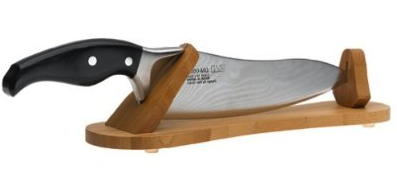
KE-DM0706 Shun Classic 8 inch Chef's Knife
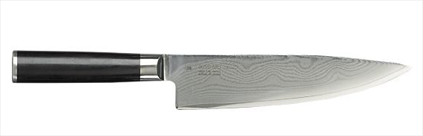
KE-DM0723 Shun Classic 6 inch Chef's Knife
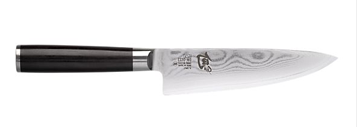
KE-DM0741 Shun U-2 6 inch Ultimate Utility Knife
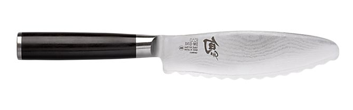
KE – DM-0717 Shun 6.5 Nakiri
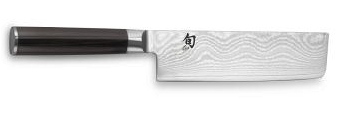
KE-DM0716 Shun Classic 4 inch Paring Knife
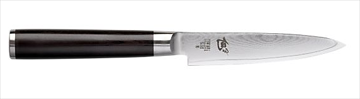
KE-DM0722 Shun Classic 6 inch Tomato Knife
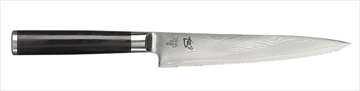
KE- DM0709 Shun Classic Straight Carving Fork

| KE-DM0703 Shun Classic 8 Inch Carving Knife 
|