HISTORY
A Dragon boat is a human-powered watercraft. It is one of a family of traditional paddled long boats found throughout Asia, Africa, the Pacific Islands and also Puerto Rico. It is one of the fastest growing sports in the Eastern and Western hemisphere as well. Almost every country now has a team or local teams or community involvement.
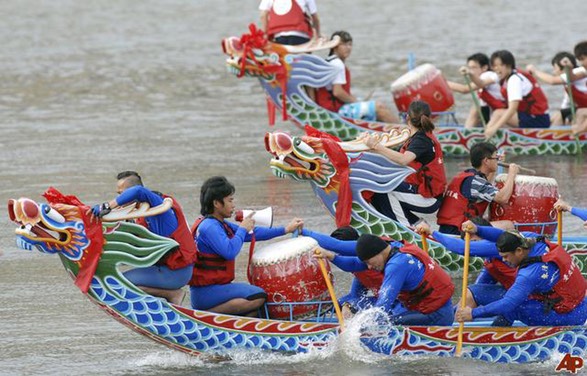
Its has been around a long time - Dragon boats are the basis of the team paddling sport which has its roots in an ancient folk ritual of contending villagers, which has been held for over 2500 years throughout southern China.
The key word is TEAM SPORT and if any sport exemplifies it, this form of racing does with winners in grueling competition sometimes less than a second apart.
It was this diversification and competition between cities, countries, families, and enemies that grew the sport into a world wide enterprise as we know it today. The picture on the right is from NY which now has a huge racing community. The Hudson never saw boats like these before.
It involves teamwork, practice, coordination, patience, strength and fortitude. The longer sprints are grueling and require a positive mental and physical attitude. You go from sitting at rest to all out energy burning, adrenalin pushed sheer strength...
While competition has taken place annually for more than 20 centuries as part of religious ceremonies and folk customs, dragon boat racing has emerged in modern times as an international sport, recognized and beginning in Hong Kong in 1976. But the history of dragon boats in competition reaches as far back as the same era as the original games of Olympia in ancient Greece.
IN THE BEGINNING
Both dragon boat racing and the ancient Olympiad included aspects of religious observances and community celebrations along with competition.
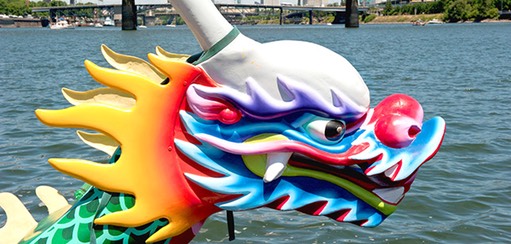
For competition events, Dragon boats are generally rigged with decorative Chinese dragon heads and tails. At other times such as during training the decorative regalia is usually removed, as it is not needed, very expensive and not worth risking. The drum often remains aboard for drummers to practice.
Similar to the use of outrigger canoes which some nations race in another competition Dragon Boat racing has a rich fabric of ancient ceremonial, ritualistic and religious traditions, and thus, the modern competitive aspect is but one small part of this complex water craftsmanship.
The use of dragon boats for racing and dragons are believed by scholars, sinologists, and anthropologists to have originated in southern central China more than 2500 years ago, in Dongting Lake and along the banks of the Chang Jiang which is now called the Yangtze during the same era when the games of ancient Greece were being established at Olympia.
The basis for annual water rituals and festival celebrations and for the traditional veneration of the Chinese dragon water deity. The celebration was an important part of the ancient Chinese agricultural society, celebrating the summer rice planting. Dragon boat racing was historically situated in the Chinese subcontinent’s southern-central "rice bowl"; where there were rice paddies, so were there dragon boats.
Of the twelve animals which make up the traditional Chinese zodiac, only the Dragon is a mythical creature. Dragons were traditionally believed to be the rulers of water on earth: rivers, lakes, and seas; they also were thought to dominate the waters of the heavens: clouds, mists, and rains. There are earth dragons, mountain dragons, and sky or celestial dragons in Chinese tradition. Mythical dragons and serpents are also found widely in many other cultures around the world.
WORLD WIDE COVERAGE
Today, dragon boat festivals continue to be celebrated around the world with dragon boat racing. These events are still culturally associated with the traditional Chinese Duen Ng Festival in Hong Kong, or Duan Wu festival in south central mainland China. Lao has become a strong advocate of the sport.

This is the San Diego Club Festival
TECHNICALS
• The crew of a standard Dragon boat is typically 22, comprising 20 paddlers in pairs facing toward the bow of the boat, 1 drummer or caller at the bow facing toward the paddlers, and 1 sweep (a steerer) standing at the rear of the boat.
• Dragon boats however vary in length and the crew size will change accordingly, from small dragon boats with 10 paddlers up to the traditional boats which have twenty crew upwards to 50 paddlers, plus drummer and sweep. It is also known long boats ( another name for Dragon Boats) may have as many as 72 paddlers.
• The pulsation of the drum beats produced by the drummer may be considered the "heartbeat" of the dragon boat. The drummer leads the paddlers throughout a race using the rhythmic drum beat to indicate the frequency and synchronicity of all the paddlers’ strokes (that is, the cadence, picking up or accelerating the pace, slowing the rate, etc.)
• The drummer may issue commands to the crew through a combination of hand signals and voice calls, and also generally exhorts the crew to perform at their peak.
A drummer is mandatory during racing events, but if he or she is not present during training, it is typical for the sweep to direct the crew. The drummer’s role is both tactical and ceremonial.
• In official competitions, such as the world championship, drummers must physically beat the drum or the team could be given a time penalty. In other events or practices an experienced team may not actually use the drum as they can paddle together naturally without listening to a beat.
• Good drummers should be able to synchronize their drumming with the strokes of the leading pair of paddlers, rather than the other way around. The paddlers sit facing forwards in the boat, and use a specific type of paddle which, (unlike rowing sweep, or scull), is not rigged to the racing watercraft in any way. Therefore, all Dragon boaters are paddlers not rowers, oarsmen or oars women, they are paddlers all.
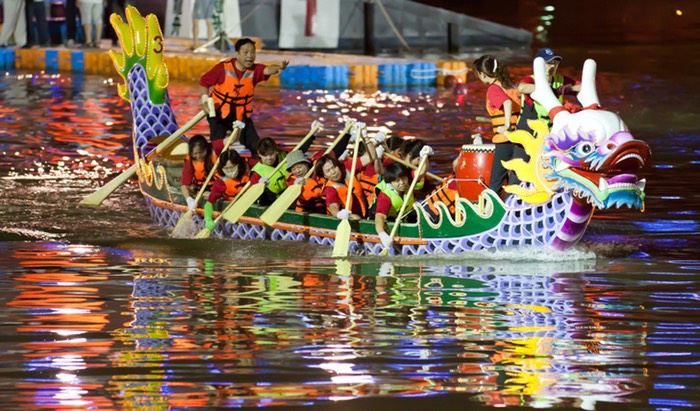
• The first pair of paddlers, called “pacers," "strokes" or "timers," set the pace for the team and are responsible for synchronizing their strokes with one another. It is critical that all paddlers are synchronised.
• The direction of the dragon boat is set by the sweep, rather than by the paddlers while actually racing.
COMMERCIAL - In Taipei the tourists get a chance to join a crew in a very ornate vessel. Sort of a Mercedes Benz of Dragon Boat racing.
THE FEDERATION - Modern dragon boat racing is organized at an international level by the International Dragon Boat Federation (IDBF) and International Canoe Federation (ICF). Although it is not officially considered a sport by the General Association of International Sports Federations (GAISF) Festival Racing is very competitive. Many competitive paddlers train all year round using paddling machines or pools to train in during the winter.
A festival race is typically a sprint event of several hundred meters with 500 meters the most common, 200, 1000 & 2000 meter races are also standard distances in international competition. 2000 meter races are normally held on a 500 meter course which teams must do two loops starting and ending at one end and completing three 180 degree turns. Other distances may also be used in local festivals such as 100 or 250 metres or another distance depending on the size of the lake or river.
LOCALLY - The Tampa Bay Area has no less than four large organizations and clubs who compete on local, state and international level, this is a bigger sport event than you might think and if you google Dragon Boat Races Tampa Bay you will be surprised. They are always competing and beginners welcome.
Lao Traditional Boat Racing Festival
LAO IS BIG IN LONG BOAT RACING - Boat racing is a local festival that takes place every year all around the country during September and October. Most Laos traditional boat racing festivals take place before and after the end of Buddhist lent. Dates vary from year to year, but most festivals are held on weekends. The pic on the right show the largest race boats, with a fifty man, woman, mixed crew.
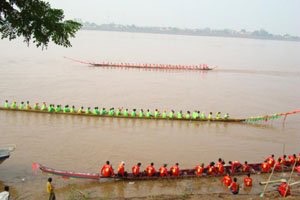 Traditionally, after the rice planting season (toward the end of rainy season) villages on the river banks prepare themselves for the upcoming boat racing festival in and around their communities. The Long boats are taken down from their houses onto the rivers. Teams of rowers start practicing weeks or months before the boat racing season arrives.
In the countryside where Lao tradition still runs deep, every household in the host village prepares special food and drinks. One type of food that almost every household prepares for their guests are noodles called Khao Poon in Lao.
As guests arrive at their houses they are offered some noodles and something to drink. This tradition has been carried on for generations and it’s also practised in boun pavet, and boun bang fai (rocket festival). It is still seen in city of Vientiane, but it is not as common and normally only happens among close families and friends.
Apart from providing food and drinks, the host village also needs to build temporary shelters for the invited guests and the rowing crews, to stay the night before the racing day. These shelters are as simple as bamboo huts or tents. Each family in the village contributes basic stuff like mattresses, pillows and blankets.
Generally all the rowing crews are provided with food, drinks and places to stay free of charge. This is the responsibility of every household in the host village as they are happy and excited to take part in the festival.
At the temple, the night, or sometimes two nights, before the race, an open air bar and dance floor are set up temporarily. All kinds of liquor is sold and a live band plays. Teenagers, men and women from the host village and from villages nearby, as well as the crews enjoy themselves drinking and dancing into the night.
In the morning, the races start around 8 am. Usually two boats race down the river for each heat. There are normally six to 10 boats participating in each festival and sometimes more if there isn’t another boat race festival taking place on that same day in nearby areas. There are prizes for winners, though they are not much, because the heart of the races is not the prize but the fun everyone has.
The races finish in the late afternoon, but that isn’t the end of the festival. Regardless of the result of the races, the celebration carries on until late or until everyone is either feeling pretty good from partying, alcohol or simply exhausted. This is a big event for locals and is only celebrated once a year, so they all want to make the most of it after working hard on their farms. Besides no designated drivers are available, none needed.
Usually after the traditional boat racing festival on the village level there is a huge boat racing festival that everyone is looking forward to. This is known to most locals as Vientiane boat racing festival. Many villages around Vientiane with racing boat entry the race at this festival.
Vientiane Boat Racing Festival
The biggest and the most significant boat racing festival Boun Xuang Heua in Laos is held at the end of Buddhist lent in Vientiane, on the Mekong River. This is known as Vientiane Boat Racing Festival and it is more or less a national festival.
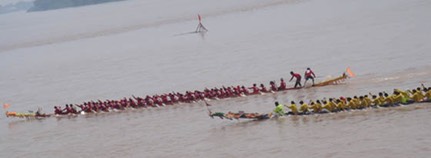
The Vientiane Boat Racing Festival is held every year, starting from the 15th day in the 11th month in lunar calendar.
The actual race is held on the 16th day, with heats starting early in the morning. Over 20 dragon boats and rower/paddler teams line up for the race on the Mekong River. The entrants come from all around Laos to compete in this significant festival.
There are usually three categories of boats: sport for men; traditional for men; and traditional for women. Teams of rowers are usually sponsored either by big name companies, such as Beer Lao, and telecom companies or by ministries or organisations in Vientiane.
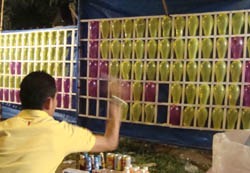
Fa Ngum road, the road along the Mekong River bank, and other streets leading to the river are lined with stalls days before the actual festival starts. These sell all kind of clothes, food (especially grilled chicken and sticky rice cooked in bamboo pipes), fruits, and drinks. There are also sideshows, such as pop-the-balloons, where small prizes can be won all over the place.
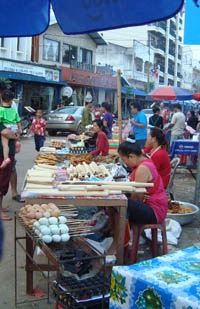
On the race day, the town comes alive with noise and festivity as the teams make their way to the river either by truck or walking, banging drums and singing. The streets to and along the Mekong River bank are very crowded as thousands of spectators cram along to cheer their teams.
Lovers of this sport make sure they get the best spot on the river bank. When the boats are racing down the river, you will hear people cheering, yelling, and banging drums along the river.
It is fun to observe and even more fun if you dare getting on the boat and be part of the rowing team. Usually the races start with the women’s teams, followed by the men’s teams. The final round happens in the afternoon and sometimes it carries on until late in the afternoon. The winner in each category receives prize money and a trophy. After the races finish, the prizes are
There is also a women’s international team, which rows with the women from one of the local villages. Details about how to join this team are normally posted in local shops or sometimes in the events section of the local paper, the Vientiane Times. This team welcomes any women, experienced or not and provides a good way for people to join in at a local level as you will be included in village activities as well.