WHICH BRINGS US TO THE "MAN OF STEEL"
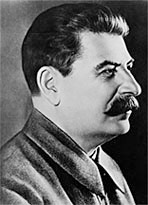 THE MAN OF STEEL
Joseph Stalin also had a few things to say. But first let me say, I am not a fan of Stalin; his one compelling virtue to me was he hated Hitler as much as I and most of the world did. Otherwise, he was no different and had as much blood on his hands as Hitler. But, if it wasn't for Hitlers egotistical stupidity in opening the second front and Stalin's tenacity, many in Europe today would be speaking German as a first language.
Stalin was Stalin, his name means Steel in Russian. He was a great motivator. Had he written more, his book could of been called "Caliber Selection in Motivation" He believed a SKS or a Tokorev to the back of the head kept an Army moving forward.
He was right. He was an innovator. In fact it was he who abolished the word “retreat” in he Russian Army and enforced it by taking the most ruthless men of the Gulags and putting them at the back of the advancing troops with orders to shoot any who fell back... the ultimate motivation policy. Go forward and possibly live or backwards and definitely die.
He controlled his Congress well; and he was a frugal conservative. He shot several of them at least once a week. No corruption, no dissidents, no complications, NO adversaries that way. His way or buried under the highway, well the ruble. And you could really call him a "fiscal conservative". He always shot people three or four tied belly to back stacked in a row to conserve bullets. Usually five was the limit.
HIS MOST PERTINENT THOUGHTS
"Everyone imposes his own system as far as his army can reach". Sounds like a situation we are in today. Our armies fighting terrorism are at the end of the reach and it is costing us in men and material and we ask the question..for what? Another book by another General.
"Mankind is divided into rich and poor, into property owners and exploited; and to abstract oneself from this fundamental division; and from the antagonism between poor and rich means abstracting oneself from fundamental facts". He should be selling real estate. Thats explains politics and the economic situation today.
Sounds like the mantra of a particular political party. The rich get richer, the poor get poorer, and one day the poor learn to shoot a gun. If you could go back through time and look at the way the other rulers of Russia kept order in their world, you would find them little different from Stalin.
The Czars were certainly not the keepers of good government. The difference was his thinking was born of a harsh war, in a harsher environment, with a fierce competitor requiring a new set of rules, wasn't pretty, but war isn't.
Nevertheless his inhumanity offset anything good he accomplished other than his aid in the destruction of the Third Reich. He was on the winning side of a horrific war but on the losing side of humanity.
STALIN - THE GAME CHANGING MOTIVATOR
Joseph Stalin had a lot to say. I was doing a paper on Roosevelt, Churchill and Stalin looking specifically at their styles of motivation they used. Roosevelt was a party builder, he brings people together for the cause, Churchill was a slogan maker that rallied people. Stalins niche was fear motivation. And it was used frequently, he created fear.
He had a problem with part of his congressional team objecting to his ideas and never showing up for work in the Russian Proletariat. That was on Tuesday, so he shot five of them, who showed up late on Wednesday. All of the rest showed up for work on Thursday quite early, since they weren't due till Friday and in a great mood. Stalin solved that problem.
But his country was faced with the German onslaught and annihilation. He knew there was little time for political pandering. He did not tolerate a lot of that, probably surpassing Hitler. His solution to the German Panzer attacks at Stalingrad, he shot deserters or retreaters at will, was feared more by his troops than to be captured by the Germans. Some said he removed the backup gears on the Russian Tanks (rumor) and his goal was to be more hated for what he could do than the Germans they were confronting. Obviously for his peasant Army it worked. And he had a few good Generals who knew war. Like Zhukov one of the best in tank warfare and turned the battlefield around.
HIS LIFE STORY FROM VARIOUS SOURCES
POLITICAL NOM: Joseph Stalin
Born; Iosif Vissarionovich Stalin
Russian: Ио́сиф Виссарио́нович Ста́лин
Born Ioseb Besarionis dze Jugashvili, Georgian
18 December 1878– 5 March 1953
De facto leader of the Soviet Union from the mid-1920s until his death in 1953.
Among the Bolshevik revolutionaries who took part in the Russian Revolution of 1917, Stalin was appointed General Secretary of the party's Central Committee in 1922. He subsequently managed to consolidate power following the 1924 death of Vladimir Lenin through suppressing Lenin's criticisms (in the postscript of his testament) and expanding the functions of his role, all the while eliminating any opposition.
By the late 1920s, he was the unchallenged leader of the Soviet Union. He remained general secretary until the post was abolished it in 1952, concurrently serving as the Premier of the Soviet Union from 1941 onward.
Under Joseph Stalin's rule, the concept of "socialism in one country" became a central tenet of Soviet society. He replaced the New Economic Policy introduced by Lenin in the early 1920s with a highly centralised command economy, launching a period of industrialization and collectivization that resulted in the rapid transformation of the USSR from an agrarian society into an industrial power.
However, the economic changes coincided with the imprisonment of millions of people in Soviet correctional labour camps ( GULUGS) and the deportation of many others to remote areas. The initial upheaval in agriculture disrupted food production and contributed to the catastrophic Soviet famine of 1932–1933, known as the Holodomor in Ukraine.
Later, in a period that lasted from 1936–39, Stalin instituted a campaign against alleged enemies of his regime called the Great Purge, in which hundreds of thousands were executed. Major figures in the Communist Party, such as the old Bolsheviks, Leon Trotsky, and several Red Army leaders, were killed after being convicted of plotting to overthrow the government and Stalin.
EDITOR: He had a no competition clause, he just shot the competition.
In August 1939, Stalin entered into a non-aggression pact with Nazi Germany that divided their influence and territory within Eastern Europe, resulting in their invasion of Poland in September of that year, but Germany later violated the agreement and launched a massive invasion of the Soviet Union in June 1941. Despite heavy human and territorial losses, Soviet forces managed to halt the Nazi incursion after the decisive Battles of Moscow and Stalingrad.
After defeating the Axis powers on the Eastern Front, the Red Army captured Berlin in May 1945, effectively ending the war in Europe for the Allies. The Soviet Union subsequently emerged as one of two recognized world superpowers, the other being the United States.
The Yalta and Potsdam conferences established communist governments loyal to the Soviet Union in the Eastern Bloc countries as buffer states, which Stalin deemed necessary in case of another invasion. He also fostered close relations with Mao Zedong in China and Kim Il-sung in North Korea.
Stalin led the Soviet Union through its post-war reconstruction phase, which saw a significant rise in tension with the Western world that would later be known as the Cold War. During this period, the USSR became the second country in the world to successfully develop a nuclear weapon, as well as launching the Great Plan for the Transformation of Nature in response to another widespread famine and the Great Construction Projects of Communism.
In the years following his death, Stalin and his regime have been condemned on numerous occasions, most notably in 1956 when his successor Nikita Khrushchev denounced his legacy and initiated a process of de-Stalinization. He remains a controversial figure today, with many regarding him as a tyrant similar to his wartime enemy Adolf Hitler; however, popular opinion within the Russian Federation is mixed.
Wikipedia has more information on this world leader.
STALIN REMEMBERED - QUOTES and THOUGHTS BY OTHERS
- As we know, the goal of every struggle is victory. But if
the proletariat is to achieve victory, all the workers, irrespective of
nationality, must be united. Clearly, the demolition of national barriers and
close unity between the Russian, Georgian, Armenian, Polish, Jewish and other
proletarians is a necessary condition for the victory of the proletariat of all
Russia.
- Some people believe that Marxism and anarchism are based on the same principles and that the disagreements between them concern only tactics, so that, in the opinion of these people, no distinction whatsoever can be drawn between these two trends. This is a great mistake. We believe that the Anarchists are real enemies of Marxism. Accordingly, we also hold that a real struggle must be waged against real enemies.
- "Marxism is not only the theory of socialism, it is an integral world outlook, a philosophical system, from which Marx’s proletarian socialism logically follows. This philosophical system is called dialectical materialism.”
- We think that a powerful and vigorous movement is impossible without differences — "true conformity" is possible only in the cemetery.
- If any foreign minister begins to defend to the death a "peace conference," you can be sure his government has already placed its orders for new battleships and airplanes.
- A sincere diplomat is like dry water or wooden iron.
- The existing pseudo-government which was not elected by the people and which is not accountable to the people must be replaced by a government recognized by the people, elected by representatives of the workers, soldiers and peasants and held accountable to their representatives.
- The press must grow day in and day out — it is our Party's sharpest and most powerful weapon.
- We disagreed with Zinoviev and Kamenev because we knew that the policy of amputation was fraught with great dangers for the Party, that the method of amputation, the method of blood-letting — and they demanded blood — was dangerous, infectious: today you amputate one limb, tomorrow another, the day after tomorrow a third — what will we have left in the Party?
- What would happen if capitalists succeeded in smashing the Republic of Soviets? There would set in an era of the blackest reaction in all the capitalist and colonial countries, the working class and the oppressed peoples would be seized by the throat, the positions of international communism would be lost.
- If the opposition disarms, all is well and good. If it refuses to disarm, we shall disarm it ourselves.
- We do not want a single foot of foreign territory; but of our territory we shall not surrender a single inch to anyone.
- Anti-Semitism, as an extreme form of racial chauvinism, is the most dangerous vestige of cannibalism. Anti-Semitism is dangerous for the toilers, for it is a false track which diverts them from the proper road and leads them into the jungle. Hence, Communists, as consistent internationalists, cannot but be irreconcilable and bitter enemies of anti-Semitism. In the U.S.S.R., anti-Semitism is strictly prosecuted as a phenomenon hostile to the Soviet system. According to the laws of the U.S.S.R. active anti-Semites are punished with death.
- We are fifty or a hundred years behind the advanced countries. We must make good this distance in ten years. Either we do it, or they will crush us. Ten years later, Nazi Germany invaded the Soviet Union.
- Mankind is divided into rich and poor, into property owners and exploited; and to abstract oneself from this fundamental division, and from the antagonism between poor and rich, means abstracting oneself from fundamental facts.
- Education is a weapon whose effects depend on who holds it in his hands and at whom it is aimed.
- The confidence of the people in the worker-directors of the economy is a great thing, Comrades. The leaders come and go, but the people remain. Only the people are immortal, everything else is ephemeral. That is why it is necessary to appreciate the full value of the confidence of the people.
- You have let down our country and our Red Army. You have the nerve not to manufacture IL-2s until now. Our Red Army now needs IL-2 aircraft like the air it breathes, like the bread it eats. Shenkman produces one IL-2 a day and Tretyakov builds one or two MiG-3s daily. It is a mockery of our country and the Red Army. I ask you not to try the government's patience, and demand that you manufacture more ILs. This is my final warning.
- Stalin said this when the enemy had reached the gate of Moscow during World War II. He called on the people not to identify all Germans with the Nazis. This leads to the conclusion, it is time to finish retreating. Not one step back! Such should now be our main slogan. ... Henceforth the solid law of discipline for each commander, Red Army soldier, and commissar should be the requirement — not a single step back without order from higher command.
- You know, they are fooling us, there is no God. We've been deceived. If God existed, he'd have made the world more just... I'll lend you a book and you'll see.
- One of Ivan the Terrible's mistakes was to overlook the five great feudal families. If he had annihilated those five families, there would definitely have been no Time of Troubles. But Ivan the Terrible would execute someone and then spend a long time repenting and praying. God got in his way in this matter. He ought to have been still more decisive!
- "Stalin's pact with Hitler” , If against all expectation, Germany finds itself in a difficult situation then she can be sure that the Soviet people will come to Germany's aid and will not allow Germany to be strangled. The Soviet Union wants to see a strong Germany and we will not allow Germany to be thrown to the ground
- This war is not as in the past; whoever occupies a territory also imposes on it his own social system. Everyone imposes his own system as far as his army can reach. It cannot be otherwise. If now there is not a communist government in Paris, this is only because Russia has no an army which can reach Paris in 1945.
- I consider it completely unimportant who in the party will vote, or how; but what is extraordinarily important is this—who will count the votes, and how. The people who cast the votes decide nothing. The people who count the votes decide everything.
- Gratitude is a sickness suffered by dogs.
- So the bastard's dead? Too bad we didn't capture him alive! Hearing of Hitler's suicide, as quoted in The Memoirs of Georgy Zhukov
- Does Djilas, who is himself a writer, not know what human suffering and the human heart are? Can't he understand it if a soldier who has crossed thousands of kilometers through blood and fire and death has fun with a woman or takes some trifle?
- In the Soviet Army, it takes more courage to retreat than advance.
- I know that after my death a pile of rubbish will be heaped on my grave, but the wind of History will sooner or later sweep it away without mercy.
- God is on your side? Is He a Conservative? The Devil's on my side, he's a good Communist.
- The Jews are not a nation!
- There are no fortresses that Bolsheviks cannot storm.
- I'm finished. I trust no one, not even myself. Do you remember the tsar? Well, I‘m like a tsar.
- "Why did you beat me so hard?” to his mother in her later years. her response was "That's why you turned out so well”.
- Stalin said this often. This seems to have originated with the Spanish military leader Juan Domingo de Monteverde, "four walls are three too many for a prison — you only need one for an execution.”
- The death of one man is a tragedy, the death of millions is a statistic.
- Death solves all problems — no man, no problem.
- We will hang the capitalists with the rope that they sell us. "If we were to hang the last capitalist, another would suddenly appear to sell us the rope”.
- Stalin was a guy like we are, not only that he considered himself a revolutionary and lived like one, but he was a character as well different than many. Stalin demonstrated outstanding brilliance as a mass leader in every revolutionary requirement: in Marxian theory, political strategy, the building of mass organizations, and in the development of the mass struggle. A man of action as well as of thought, he exemplified in his activities that coordination of theory and practice which is so indispensable to the success of the every-day struggles of the masses and the final establishment of socialism.
- Stalin was, Mr. Montefiore, writes, “that rare combination: both ‘intellectual’ and killer.” The roots of violence ran deep in his family life and in Gori, his hometown, where street brawling was the principal sport.
- Soso, as Stalin, born Josef Djugashvili, was called, suffered savage beatings from both his alcoholic father and his doting mother, who alternated smothering affection with harsh corporal punishment.
When Stalin, later in life, asked his mother why she had beaten him so much, she replied, “It didn’t do you any harm.” A brilliant but rebellious student at the religious schools he attended, and a published poet of great promise,
Soso took up radical politics while still in his teens, his approach already shaped by the tactics of the seminary’s administration — “surveillance, spying, invasion of inner life, violation of feelings,” as he later described them.
- The German-Soviet pact was...a shameless exhibition, on Stalin's part, of complete indifference to the fate of the working-class outside the Soviet Union: and the attack on Finland, like the absorption of the Baltic Republics, was an example of strategic imperialism.
- Humans beings do respond to love; they do have a feeling for truth and justice, they do dislike authority and repression; they do have prejudices against murder... The Stalin Regime has done its best to bring out in the Russians the reverse of the feelings listed above.
- You protest, and with justice, each time Hitler jails an opponent; but you forget that Stalin and company have jailed and murdered a thousand times as many. It seems to me, and indeed the evidence is plain, that compared to the Moscow brigands and assassins, Hitler is hardly more than a common Ku Kluxer and Mussolini almost a philanthropist.
- I would not condemn Stalin and his associates merely for their barbaric and undemocratic methods. It is quite possible that, even with the best intentions, they could not have acted otherwise under the conditions prevailing there.
- But on the other hand it was of the utmost importance to me that people in western Europe should see the Soviet regime for what it really was.
WHO WAS HE
I was struck by clear signs of its
transformation into a hierarchical society, in which the rulers have no more
reason to give up their power than any other ruling class. Moreover, the
workers and intelligentsia in a country like England cannot understand that the
USSR of today is altogether different from what it was in 1917.
It is partly that they do not want to understand (i.e. they want to believe that, somewhere, a really Socialist country does actually exist), and partly that, being accustomed to comparative freedom and moderation in public life, totalitarianism is completely incomprehensible to them.
The late Leonid Krasin ... was the first, if I am not mistaken, to call Stalin an "Asiatic". In saying that, he had in mind no problematical racial attributes, but rather that blending of grit, shrewdness, craftiness and cruelty which has been considered characteristic of the statesmen of Asia.
Bukharin subsequently simplified the appellation, calling Stalin "Genghis Khan", manifestly in order to draw attention to his cruelty, which has developed into brutality. Stalin himself, in conversation with a Japanese journalist, once called himself an "Asiatic", not in the old, but rather in the new sense of the word: with that personal allusion he wished to hint at the existence of common interests between the USSR and Japan as against the imperialistic West.